Posts tonen met het label Alsace. Alle posts tonen
woensdag 19 september 2012
Wat anders naast de wijnen ?
Vindt u vier wijnproeverijen en/of zo'n 20 glazen Elzaswijn (of meer) wat veel voor een dag dan hebben we ook alternatieven voor u.
Wat te denken van een halve dag wijnproeven en dan 's middags eens wat anders?
Een middeleeuws kasteel
Een mooi gelegen en prachtig gerestaureerd kasteel is het chateau Haut Koenigsbourg. Dit kasteel komen we in de geschiedenis al tegen in 1147. Plunderingen, branden ..., natuurlijk ademt het kasteel geschiedenis.
Rond 1899 was het eigendom van de duitse keizer Wilhelm II. Begin 1900 begon men al met de restauratie die leidde tot wat er nu staat.
Een bezoek aan dit kasteel is leuk voor jong en oud. We nemen u graag mee.
Roofvogels
Vlakbij Haut Koenigsbourg is de Volerie des Aigles. Dit is geen suffe mini-dierentuin met wat uitgebluste roofvogels.
Om te beginnen de locatie is schitterend. U heeft een prachtig uitzicht over de Elzas en haar wijngebieden.
Een groot aantal roofvogels leeft hier semi-vrij. In een aantal demonstraties laat men u zien wat die vogels zo al doen en kunnen.
Geloof me, als 6 kg vogel en ruim 2 meter spanwijdte vlak over uw hoofd suist bent u onder de indruk. Gaaf !!
Kaas
In Frankrijk vinden we natuurlijk talloze kazen. Bekend in onze regio is onder meer de Munster kaas. Laat nu het stadje Munster op een kwartier rijden van Colmar liggen. In dit gebied liggen diverse kaasboerderijen waar veelal artisinaal en met het oog op traditie Munsterkaas wordt gemaakt.
Natuurlijk kunt u de diverse kazen op verschillende locaties ook proeven en meenemen. Een Munsterkaas in combinatie met een Gewurztraminer Elzaswijn is dan een mooie afsluiting.
Nog even wat betreft dat kopen en meenemen. Kan zeker, is een aanrader .... alleen het zijn sterke kazen. Uw koffer, auto of hotelkamer zal u nog tijden herinneren aan dit aangename stukje natuurprodukt.
Wat te denken van een halve dag wijnproeven en dan 's middags eens wat anders?
Een middeleeuws kasteel
Een mooi gelegen en prachtig gerestaureerd kasteel is het chateau Haut Koenigsbourg. Dit kasteel komen we in de geschiedenis al tegen in 1147. Plunderingen, branden ..., natuurlijk ademt het kasteel geschiedenis.
Rond 1899 was het eigendom van de duitse keizer Wilhelm II. Begin 1900 begon men al met de restauratie die leidde tot wat er nu staat.
Een bezoek aan dit kasteel is leuk voor jong en oud. We nemen u graag mee.
Roofvogels
Vlakbij Haut Koenigsbourg is de Volerie des Aigles. Dit is geen suffe mini-dierentuin met wat uitgebluste roofvogels.
Om te beginnen de locatie is schitterend. U heeft een prachtig uitzicht over de Elzas en haar wijngebieden.
Een groot aantal roofvogels leeft hier semi-vrij. In een aantal demonstraties laat men u zien wat die vogels zo al doen en kunnen.
Geloof me, als 6 kg vogel en ruim 2 meter spanwijdte vlak over uw hoofd suist bent u onder de indruk. Gaaf !!
Kaas
In Frankrijk vinden we natuurlijk talloze kazen. Bekend in onze regio is onder meer de Munster kaas. Laat nu het stadje Munster op een kwartier rijden van Colmar liggen. In dit gebied liggen diverse kaasboerderijen waar veelal artisinaal en met het oog op traditie Munsterkaas wordt gemaakt.
Natuurlijk kunt u de diverse kazen op verschillende locaties ook proeven en meenemen. Een Munsterkaas in combinatie met een Gewurztraminer Elzaswijn is dan een mooie afsluiting.
Nog even wat betreft dat kopen en meenemen. Kan zeker, is een aanrader .... alleen het zijn sterke kazen. Uw koffer, auto of hotelkamer zal u nog tijden herinneren aan dit aangename stukje natuurprodukt.
donderdag 9 februari 2012
zondag 26 juni 2011
zondag 14 december 2008
vrijdag 5 december 2008
Wine pairing tool

Destination Riesling : http://www.destinationriesling.com and the Riesling Pairing Tool.
Gevonden tool om wijn en spijs met elkaar te combineren.
"The tool guides users through a simple, step-by-step process of either matching wine to food or food to wine. Riesling (as well as other select wines from Germany, Austria and Alsace)."
donderdag 28 augustus 2008
Domaine Baumann Zirgel
Op de markt van Gerardmer kwamen we in contact met het Elzaswijnhuis Baumann Zirgel. Op markten verwacht je nu niet meteen iets aparts. Maar ach ... aardige vent, toch even proeven, je weet nooit.
Ik nam een Riesling Streng 2007 en vrouwlief een glas Cremant, de simpelste Brut.
Lekker! We proefde beiden iets van amandel in de afdronk. Leuk!!
Toch een verrassing!
Genoeg reden voor ons om het huis eens 'echt' te bezoeken. Dat hebben we gisteren gedaan. Aardige mensen, die de tijd voor je nemen. Er werden nog twee bussen voor een bezoek en een proeverij uitgeladen, dus het werd op een gegeven moment echt druk.
De Riesling Streng is fris niet 'te' zuur en zoals gezegd komt er aan het einde die amandel smaak doorheen. Prima en een redelijke prijs: euro 8,20. Vervolgens ook een Riesling Schlossberg geproefd. Kernachtig, krachtig, vol aroma's, mooi dik en rond. Deze wijn kun je een hele tijd bewaren en onderweg zal hij nog regelmatig van gedaante wijzigen. Prijs euro 14,90.
Iets wat we niet zo vaak meemaken: we proefden naast de Cremant die we al kenden (Brut - 8 euro) nog een AOC Cremant van euro 15,= . De fles was al open geweest en viel ons een beetje tegen. Dat kon natuurlijk niet! Zonder problemen werd een nieuwe fles geopend. (...) Dat maken we ook wel anders mee!
We vroegen 'meneer' of hij ook een Rose Cremant maakt. Hadden we net 's middags van een ander huis geproefd. Helaas niet .... hij wil dat wel eens proberen, maar zijn vrouw was nog niet overtuigd. Nu ja....:-))
Onze conclusie: mooie wijnen die qua smaak boven de middelmaat uitsteken zonder tegelijk duur te worden. We nemen BAUMANN - ZIRGEL zeker op bij onze groepsbezoeken en proeverijen.
BAUMANN - ZIRGEL
5 Rue du vignoble
68630 MITTELWIHR
Tél : 03 89 47 90 40
Fax : 03 89 49 04 89
Internet : www.baumann-zirgel.com
Contact(s) :
MM. et Mmes Jean-Jacques & Nicole, Benjamin & Valérie ZIRGEL
vrijdag 11 april 2008
Biologische en biodynamische wijnmakers
Biologische en biodynamische wijnmakers zien we relatief veel in de Elzas. Bijvoorbeeld bij Zind Humbrecht. Alle wijnbouw gebeurt hier op biologisch-dynamische wijze: geen kunstmest, geen herbiciden, pluk met de hand (geen tractoren die de toplaag verdichten), etc. Dit vereist heel veel aanpassing omdat wijnbouw in principe een monocultuur is en daarmee extra vatbaar voor ziekten en plagen.
Een leuk artikel vond ik in de Caterer & Hotelkeeper; u vindt het hieronder.
If I told you that a biodynamic winemaker takes the flower heads of yarrow, fermented in a stag's bladder, and applies them to compost, or that he ferments oak bark in the skull of a domestic animal, you would think he was a bit nuts, wouldn't you? That's why people don't shout about it - it's just too weird.
But such processes seem to work. Some of the world's greatest wine producers are already making wine biodynamically, and increasing numbers are dabbling in it, from California to Australia, Chile to South Africa, Italy to France - especially France.
So what exactly is biodynamic winemaking? Good question. Let me say that many winemakers who do it don't fully understand it. "It's like Japanese: if you jump straight into it, it's too esoteric, too strange," says Alsace biodynamic winemaker André Ostertag.
Another convert, Dominique Lafon, from the great Meursault estate of the same name, adds: "At first you can't believe the stories that you hear, but once you see for yourself what is going on in the vineyard, you are more ready to accept it."
The term "biodynamic" translates roughly from its Greek roots as meaning "working with life energies". Biodynamic wines are those made from grapes grown following the principles of biodynamic agriculture, stemming from a series of lectures delivered by Rudolf Steiner (1861-1925), linking man, the earth and the cosmos.
Steiner believed: "It is impossible to understand plant life without taking into account that everything on Earth is actually only a reflection of what is taking place in the cosmos." The biodynamic farmer thus sees the farm in the context of a wider pattern of lunar and cosmic rhythms. No synthetic fertilisers or pesticides are used here instead, they use a range of special preparations (the aforementioned oak bark, etc) to boost the productivity of the soil. These are diluted, then applied in homeopathic quantities determined by the position and influences of the sun, moon and stars.
The height of the moon, for example, is crucial to the planting cycle. When the moon is descending, sap flows downwards and things don't grow as fast (including your hair, apparently - so it's a good time to get it cut), making this the best time to plant young vines. But that, of course, depends on where you are in the signs of the zodiac. I told you it was weird.
The days in the biodynamic agricultural calendar are divided up according to the signs of the zodiac. There are root days (earth signs - Taurus, Virgo, Capricorn), leaf days (water signs - Cancer, Scorpio, Pisces), flower days (air signs - Gemini, Aquarius, Libra) and fruit days (fire signs - Leo, Sagittarius, Aries). If you plant your potatoes on a root day in a falling moon, you'll have a perfect crop - or something like that. This is organic farming with knobs on.
It sounds mysterious, I know, but grape growers who have embraced the system report great improvements in the health of their vineyards, while winemakers claim to produce cleaner, more vibrant wines.
Lafon, who first started experimenting with biodynamics more than 10 years ago, says: "You see better growth in the vineyard - longer shoots, with roots that go really deep. I saw a vineyard that was almost dead double its crop after being farmed biodynamically."
And he declares: "Our fruit is riper, more intense, and better balanced in terms of acidity, with a more even crop. And all of us have felt that there's more energy in the wines - in the whites, especially."
There are more than 20 producers in Burgundy who are into biodynamics, but Alsace boasts more than anywhere else in the world. "I guess it's a question of geography - Steiner's influence along the Rhine," explains Ostertag, who first experimented with it in 1997.
He, too, saw a virused vineyard spring back to life with biodynamics. "I was so impressed, I had to try it," he says. "It became less and less strange as I went along, though I can't explain why it works. Even scientists don't understand how it works. It's not rational, and I'm a really rational person. I don't think about it too much, I just do it."
You'll have to do your homework to search out biodynamic producers - most don't exactly shout about it (it's a spiritual thing, rather than a marketing thing), and give no indication on the back labels. Those that do so open up another can of worms, as very few growers are certified biodynamic (Demeter, a certified trademark of the Biodynamic Agricultural Association, is the main certifying body in the UK).
You could always search out Frederic Grappe. He runs Dynamic Vines, the first wine supplier to concentrate on biodynamic wines. His name might be familiar to many in the industry - he was formerly head sommelier at both Orrery and Roussillon restaurants in London. He has about 70 biodynamic wines on his books, from 18 different producers - all French, except one from Spain. And, yes, his on-trade accounts are mostly top-end, so far.
Grappe says: "I feel that these wines really need to be explained, so I need passionate people buying them, with serious lists." That said, one of his biggest customers is a modest French bistro, La Trouvaille, off London's Carnaby Street, whose co-owner, Guillaume Siard, is now a huge fan of biodynamic wines and lists 85 of them on his 100-bin list.
The bistro didn't start out that way, however. "When we opened eight years ago," Siard says, "we specialised in wines from the South of France, but we realised that most of the wines that we had chosen for the list were made organically or biodynamically. I am drawn to wines that have pure flavours, a vibrancy, balance and authenticity - which these have. But you need to choose carefully. Just because the wines are organic and biodynamic doesn't mean they are good."
He does attempt to explain biodynamics on his list, but to keep things simple he marks each wine with an "N" for natural. He explains: "It's much easier that way, as some aren't certified organic or biodynamic, and some are."
Grappe has lots of explaining to do, but most people get it, he says. "Restaurant wine buyers are becoming increasingly bored with the globalisation of wines - the lack of identity and character," he believes. "Biodynamic wines are just so much more authentic - closer to the area they come from."
This is what drew him to biodynamic wines in the first place. "My palate was just moving closer and closer to these kinds of wines," he explains. "It's not just about the wines, either, it's about the people behind it. And there are more and more winemakers moving in this direction. In France, they were seen as complete freaks up until five years ago. Some people still think that."
You can't really blame them. Biodynamic winemaking has provoked a fair amount of scepticism, especially in the scientific community, who are put off by its rather esoteric, cultish image. And no full studies have been conducted yet, which would help its wider acceptance.
Nobody can say for sure how biodynamics contributes to these wines. There aren't any non-biodynamic wines made by the same producers in the same way to compare them against, and the practice has picked up only in the past 10 years.
Biodynamic agriculture is tricky and precise, and requires an enormous commitment from the winemaker, but the fact remains that some of the best vineyards - and vegetable gardens - in the world are biodynamic.
Source: Caterer & Hotelkeeper
Een leuk artikel vond ik in de Caterer & Hotelkeeper; u vindt het hieronder.
If I told you that a biodynamic winemaker takes the flower heads of yarrow, fermented in a stag's bladder, and applies them to compost, or that he ferments oak bark in the skull of a domestic animal, you would think he was a bit nuts, wouldn't you? That's why people don't shout about it - it's just too weird.
But such processes seem to work. Some of the world's greatest wine producers are already making wine biodynamically, and increasing numbers are dabbling in it, from California to Australia, Chile to South Africa, Italy to France - especially France.
So what exactly is biodynamic winemaking? Good question. Let me say that many winemakers who do it don't fully understand it. "It's like Japanese: if you jump straight into it, it's too esoteric, too strange," says Alsace biodynamic winemaker André Ostertag.
Another convert, Dominique Lafon, from the great Meursault estate of the same name, adds: "At first you can't believe the stories that you hear, but once you see for yourself what is going on in the vineyard, you are more ready to accept it."
The term "biodynamic" translates roughly from its Greek roots as meaning "working with life energies". Biodynamic wines are those made from grapes grown following the principles of biodynamic agriculture, stemming from a series of lectures delivered by Rudolf Steiner (1861-1925), linking man, the earth and the cosmos.
Steiner believed: "It is impossible to understand plant life without taking into account that everything on Earth is actually only a reflection of what is taking place in the cosmos." The biodynamic farmer thus sees the farm in the context of a wider pattern of lunar and cosmic rhythms. No synthetic fertilisers or pesticides are used here instead, they use a range of special preparations (the aforementioned oak bark, etc) to boost the productivity of the soil. These are diluted, then applied in homeopathic quantities determined by the position and influences of the sun, moon and stars.
The height of the moon, for example, is crucial to the planting cycle. When the moon is descending, sap flows downwards and things don't grow as fast (including your hair, apparently - so it's a good time to get it cut), making this the best time to plant young vines. But that, of course, depends on where you are in the signs of the zodiac. I told you it was weird.
The days in the biodynamic agricultural calendar are divided up according to the signs of the zodiac. There are root days (earth signs - Taurus, Virgo, Capricorn), leaf days (water signs - Cancer, Scorpio, Pisces), flower days (air signs - Gemini, Aquarius, Libra) and fruit days (fire signs - Leo, Sagittarius, Aries). If you plant your potatoes on a root day in a falling moon, you'll have a perfect crop - or something like that. This is organic farming with knobs on.
It sounds mysterious, I know, but grape growers who have embraced the system report great improvements in the health of their vineyards, while winemakers claim to produce cleaner, more vibrant wines.
Lafon, who first started experimenting with biodynamics more than 10 years ago, says: "You see better growth in the vineyard - longer shoots, with roots that go really deep. I saw a vineyard that was almost dead double its crop after being farmed biodynamically."
And he declares: "Our fruit is riper, more intense, and better balanced in terms of acidity, with a more even crop. And all of us have felt that there's more energy in the wines - in the whites, especially."
There are more than 20 producers in Burgundy who are into biodynamics, but Alsace boasts more than anywhere else in the world. "I guess it's a question of geography - Steiner's influence along the Rhine," explains Ostertag, who first experimented with it in 1997.
He, too, saw a virused vineyard spring back to life with biodynamics. "I was so impressed, I had to try it," he says. "It became less and less strange as I went along, though I can't explain why it works. Even scientists don't understand how it works. It's not rational, and I'm a really rational person. I don't think about it too much, I just do it."
You'll have to do your homework to search out biodynamic producers - most don't exactly shout about it (it's a spiritual thing, rather than a marketing thing), and give no indication on the back labels. Those that do so open up another can of worms, as very few growers are certified biodynamic (Demeter, a certified trademark of the Biodynamic Agricultural Association, is the main certifying body in the UK).
You could always search out Frederic Grappe. He runs Dynamic Vines, the first wine supplier to concentrate on biodynamic wines. His name might be familiar to many in the industry - he was formerly head sommelier at both Orrery and Roussillon restaurants in London. He has about 70 biodynamic wines on his books, from 18 different producers - all French, except one from Spain. And, yes, his on-trade accounts are mostly top-end, so far.
Grappe says: "I feel that these wines really need to be explained, so I need passionate people buying them, with serious lists." That said, one of his biggest customers is a modest French bistro, La Trouvaille, off London's Carnaby Street, whose co-owner, Guillaume Siard, is now a huge fan of biodynamic wines and lists 85 of them on his 100-bin list.
The bistro didn't start out that way, however. "When we opened eight years ago," Siard says, "we specialised in wines from the South of France, but we realised that most of the wines that we had chosen for the list were made organically or biodynamically. I am drawn to wines that have pure flavours, a vibrancy, balance and authenticity - which these have. But you need to choose carefully. Just because the wines are organic and biodynamic doesn't mean they are good."
He does attempt to explain biodynamics on his list, but to keep things simple he marks each wine with an "N" for natural. He explains: "It's much easier that way, as some aren't certified organic or biodynamic, and some are."
Grappe has lots of explaining to do, but most people get it, he says. "Restaurant wine buyers are becoming increasingly bored with the globalisation of wines - the lack of identity and character," he believes. "Biodynamic wines are just so much more authentic - closer to the area they come from."
This is what drew him to biodynamic wines in the first place. "My palate was just moving closer and closer to these kinds of wines," he explains. "It's not just about the wines, either, it's about the people behind it. And there are more and more winemakers moving in this direction. In France, they were seen as complete freaks up until five years ago. Some people still think that."
You can't really blame them. Biodynamic winemaking has provoked a fair amount of scepticism, especially in the scientific community, who are put off by its rather esoteric, cultish image. And no full studies have been conducted yet, which would help its wider acceptance.
Nobody can say for sure how biodynamics contributes to these wines. There aren't any non-biodynamic wines made by the same producers in the same way to compare them against, and the practice has picked up only in the past 10 years.
Biodynamic agriculture is tricky and precise, and requires an enormous commitment from the winemaker, but the fact remains that some of the best vineyards - and vegetable gardens - in the world are biodynamic.
Source: Caterer & Hotelkeeper
Kientzheim, Confrérie en 007.
Het kasteel van Kientzheim (Conesheim) wordt al genoemd rond het jaar 785. (NB. De link geeft u een blik op Kientzheim met Google Earth.)
Verschillende heren van Hohlandsberg (huis van Habsburg) bewoonden het landgoed in de middeleeuwen. In de 16e eeuw werd Kientzheim eigendom van Lazarus von Schwendi. Hij was het die hier de Tokay introduceerde.
In Kientzheim zien we onder meer de overblijfselen van een Romeinse villa en last but not least het kasteel van Schwendi, dat tegenwoordig behoort aan de "Confrerie Saint-Etienne d'Alsace".
U kunt hier kennismaken met Elzaswijnen en eventueel zelfs het kasteel afhuren voor een feest oid.
Van de website: En 2007, la Confrérie a retenu les dates et les thèmes suivants :
Samedi 2 juin 2007 Chapitre de la Vigne en fleur « 7 Péchés capitaux »
Samedi 16 juin 2007 Chapitre de l’Eté « 7 Cépages d'Alsace »
Samedi 8 septembre 2007 Chapitre d’Automne « OO7 »
Samedi 22 septembre 2007 Chapitre des Vendanges « 7 Merveilles du monde »
Lundi 26 novembre 2007 Chapitre des Métiers de Bouche « 7 Jours de la semaine »
dinsdag 11 maart 2008
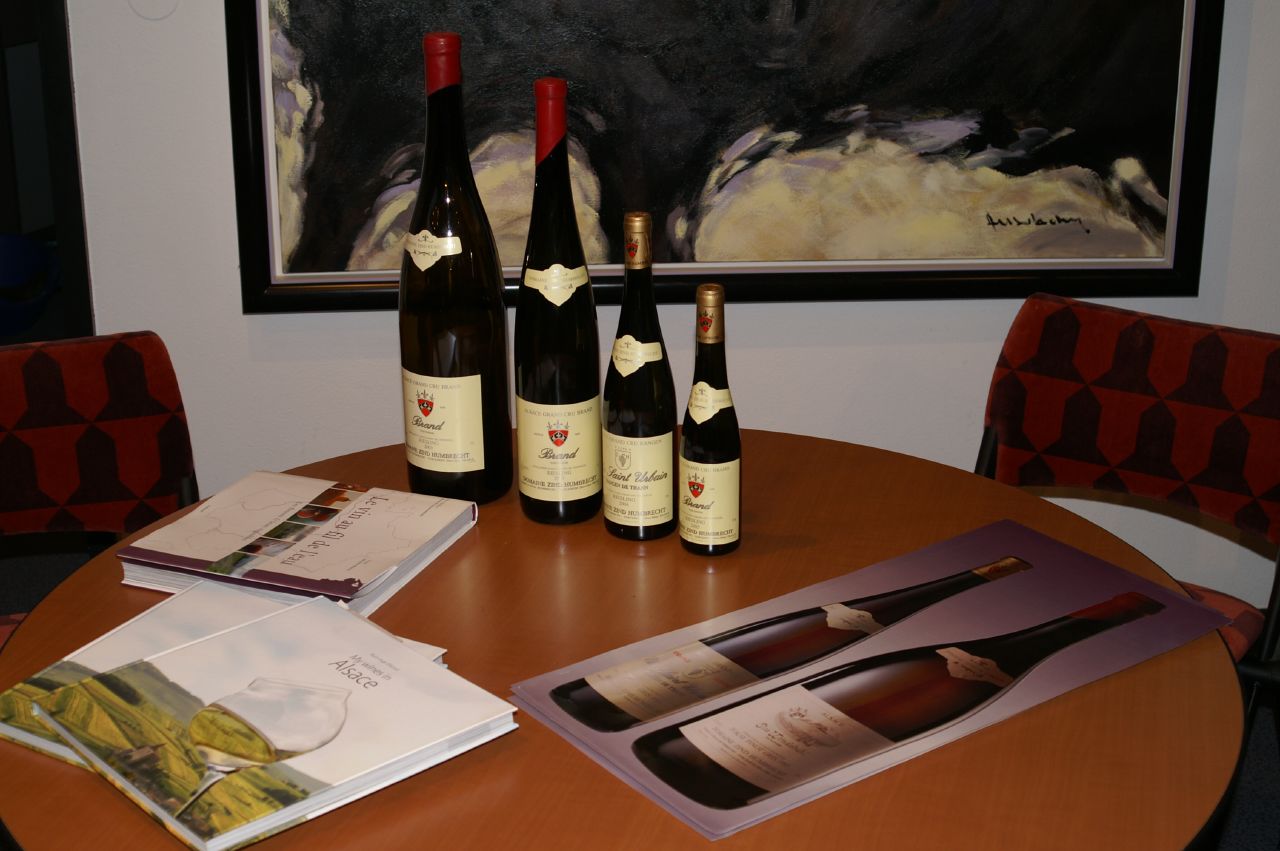
Proeverij Zind Humbrecht 2006 - 10 maart 2008
Op 10 maart jl waren we te gast bij Zind Humbrecht om een aantal wijnen van 2006 te proeven. We proefden o.m. diverse: Pinot Gris, Gewurztraminer en Muscat wijnen. Prachtige wijnen stuk voor stuk. En natuurlijk een aantal Vendange Tardives en Rieslings.
Voor ons is de ZIND van Zind Humbrecht geen typische Elzaswijn. Maar daarom niet minder plezierig. Hij wordt gemaakt van 65% Chardonnay en 35% Auxerrois en verbouwd op kalkrijke grond. We proefden een droge, ietwat lichte fruitige wijn.
Zoals u weet geeft de grondsoort (terroir) een belangrijke bijdrage aan de smaak van een wijn. Kalk, graniet, loss, etc geven elk hun eigen bijdrage aan de smaak.
Percelen die de regen goed kwijt kunnen laten de druiven ahw sterker smaken; de suikers blijven beter bewaard en worden minder verdund.
Bij Zind Humbrecht kan men o.m. veel verschillende Rieslings proeven en kopen. Van droge, zure zeer kernachtige wijnen tot bijna honingachtige lieve wijnen. (Vendange Tardives) Men maakt bij Zind Humbrecht ook mixes van (bijvoorbeeld) Rieslings, maar afkomstig van verschillende percelen.
De zeer jonge wijndruiven van de Grand Cru Brand worden via de cooperatie Turckheim verkocht. Deze en andere Turckheim Rieslings en wijnen zitten bij ons standaard in de proeverijen. Van de jaargang 2006 is ook een Vendange Tardive gemaakt.
Deze Riesling is beslist een aanrader. Hij is fruitig en expressief.
De Riesling Brand 2006 van Zind Humbrecht zelf is zeer bijzonder. Een zeer rijke wijn (pourriture noble!) met een prachtige neus. Fruit, honing, ciderachtig, een prachtig complex palet. Een wijn die je langer open kunt laten staan. Hoe meer zuurstof hij krijgt, hoe meer aroma’s zich ontwikkelen.
Dit is een wijn die vanaf 2016 op zijn hoogtepunt is. En die je kunt bewaren toch 2036.... zeggen ze bij Zind Humbrecht. Wow dan ben ik langzamerhand een oude man. Met een mooi vooruitzicht, dat wel...
woensdag 27 februari 2008
Katholiek of protestant: twee stijlen van wijn maken
Onderstaand artikel kwam ik tegen op wijnerij.web-log.nl:
NB. 'Ik' is de schrijver 'Ed'.
"Enige jaren geleden las 'ik' ergens een mooie vergelijking tussen twee stijlen van wijn maken in de Elzas. De zogenaamde Katholieke en Protestantse stijl.
De Katholieke stijl met Barokke, uitbundige wijnen, met een heel uitgebreid smaakpallet, vaak in combinatie met een klein zoetje. Dit in tegenstelling tot de Protestantse stijl, waar de wijnen ingetogen, zuiver, strak, en droog gevinifieerd worden.
Een voorbeeld van de Katholieke school is Domaine Zind Humbrecht en volgelingen, terwijl typische exponenten van de Protestantse stijl Hugel & Fils en Domaine Trimbach genoemd mogen worden.
Of bovengenoemde vergelijking hout snijd, zou ik niet durven te zeggen, maar ik vond het wel een mooie typering voor de verschillende wijnstijlen in de Elzas.
Kwaliteit, traditie en ervaring zijn de typische kenmerken van Domaine Trimbach, maar ook van conculega Hugel & Fils. Zij doen absoluut geen concessie aan de gangbare trend in de Elzas, om steeds zoetere wijnen te maken.
In het blad Proefschrift, sprak Etienne Hugel van Hugel & Fils geringschattend over de 'suikerclub', doelend op die producenten die achter de commercie op korte termijn aanlopen en zoete, inhoudloze of karakterloze Elzaswijnen produceren."
Begin maart gaan wij van JoliSoleil 2007 wijnen proeven bij Zind Humbrecht. Ik zal er een protestantse fles van Trimbach of Hugel naast zetten. Benieuwd of de vergelijking op gaat.
Tjee, zijn we nu katholiek of protestant ...
NB. 'Ik' is de schrijver 'Ed'.
"Enige jaren geleden las 'ik' ergens een mooie vergelijking tussen twee stijlen van wijn maken in de Elzas. De zogenaamde Katholieke en Protestantse stijl.
De Katholieke stijl met Barokke, uitbundige wijnen, met een heel uitgebreid smaakpallet, vaak in combinatie met een klein zoetje. Dit in tegenstelling tot de Protestantse stijl, waar de wijnen ingetogen, zuiver, strak, en droog gevinifieerd worden.
Een voorbeeld van de Katholieke school is Domaine Zind Humbrecht en volgelingen, terwijl typische exponenten van de Protestantse stijl Hugel & Fils en Domaine Trimbach genoemd mogen worden.
Of bovengenoemde vergelijking hout snijd, zou ik niet durven te zeggen, maar ik vond het wel een mooie typering voor de verschillende wijnstijlen in de Elzas.
Kwaliteit, traditie en ervaring zijn de typische kenmerken van Domaine Trimbach, maar ook van conculega Hugel & Fils. Zij doen absoluut geen concessie aan de gangbare trend in de Elzas, om steeds zoetere wijnen te maken.
In het blad Proefschrift, sprak Etienne Hugel van Hugel & Fils geringschattend over de 'suikerclub', doelend op die producenten die achter de commercie op korte termijn aanlopen en zoete, inhoudloze of karakterloze Elzaswijnen produceren."
Begin maart gaan wij van JoliSoleil 2007 wijnen proeven bij Zind Humbrecht. Ik zal er een protestantse fles van Trimbach of Hugel naast zetten. Benieuwd of de vergelijking op gaat.
Tjee, zijn we nu katholiek of protestant ...
donderdag 21 februari 2008
Wijnbeurs 15-19 februari 2008 - kort verslag
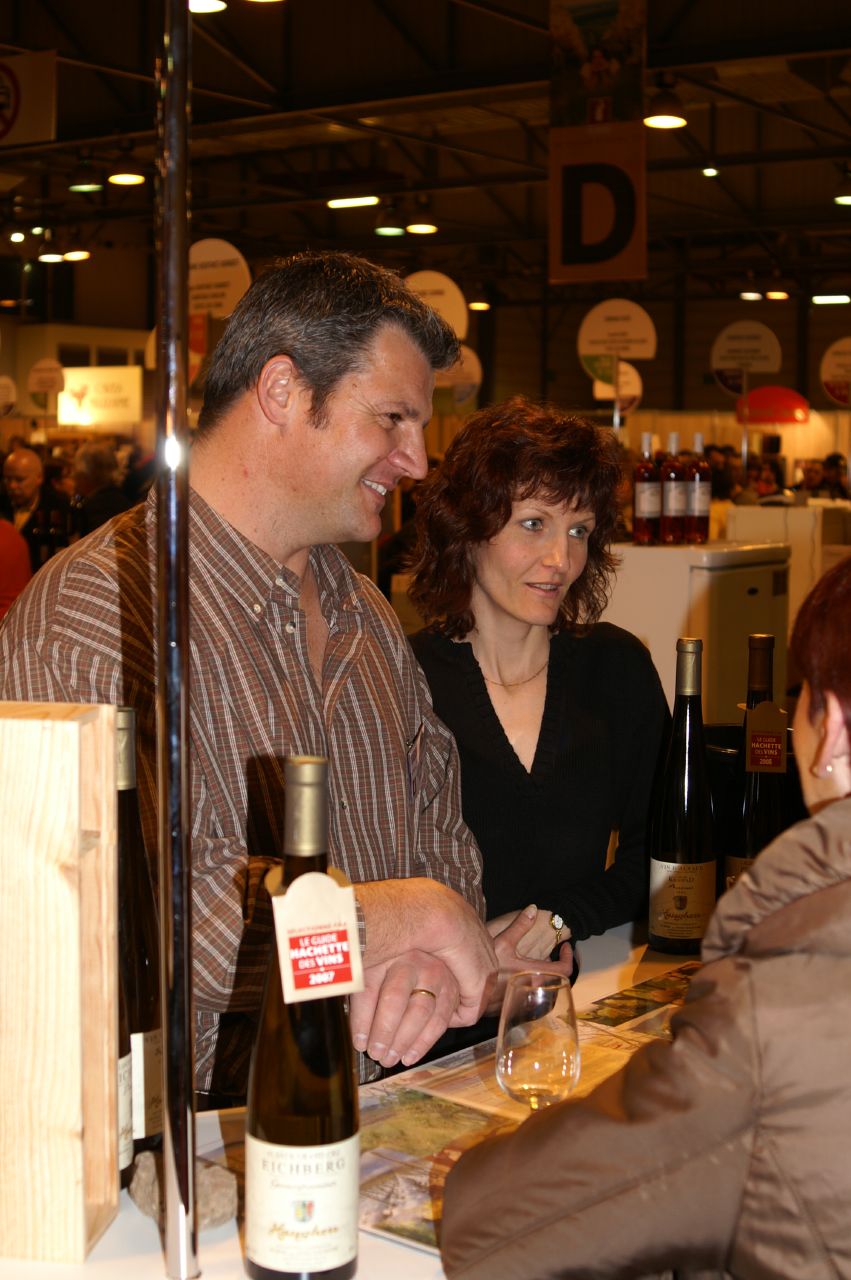
Op de wijnbeurs die onlangs in Straatsburg werd gehouden hebben we alle Elzas stands bezocht. We proefden wijnen (vooral Rieslings en Cremants) en spraken met de mensen van:
- Domaine Mittnacht – Klack ; http://www.mittnacht.fr/
- Domaine de l’Orient – Gerard Weinzorn et Fils
- Vins d’Alsace Hausherr ; Hubert & Heidi (zie foto)
- Andre Hartmann
- Serge & Gerard Hartmann
- Domaine Fleischer – fruchtige Riesling http://www.domaine-fleischer.com/
- Vins Spitz & Fils
- Rene Koch & Fills http://www.vin-koch.fr.st/
- Domaine Mittnacht – Klack ; http://www.mittnacht.fr/
- Domaine de l’Orient – Gerard Weinzorn et Fils
- Vins d’Alsace Hausherr ; Hubert & Heidi (zie foto)
- Andre Hartmann
- Serge & Gerard Hartmann
- Domaine Fleischer – fruchtige Riesling http://www.domaine-fleischer.com/
- Vins Spitz & Fils
- Rene Koch & Fills http://www.vin-koch.fr.st/
Een paar uitschieters zijn er natuurlijk altijd. De verschillende Grand Cru’s zullen de komende tijd bij ons op tafel staan en nader aan de tand worden gevoeld..
Grappig blijven alle namen van de verschillende stukjes land en hellingen (Herrenberg, Brand, Steinert, etc. ) Terroir blijft natuurlijk enorm belangrijk voor de uiteindelijke smaak van de wijn.
We gingen nog even vreemd bij Pomerol en Pauillac. Daarover later meer!
woensdag 13 februari 2008
Seminars Alsace wijnen 2008 – Programma
Vele vragen worden gesteld:
› Aroma van witte bloemen of exotische vruchten?
› Wat is een vin de terroir?
› Waarom zijn er zoveel druivenrassen in de Alsace?
› Past een witte wijn bij vlees?
› Kunnen Alsace wijnen lang bewaard worden?
› Wat is het verschil tussen een Riesling en een Sylvaner?
› Wat is de méthode traditionnelle?
Om dit soort vragen te kunnen beantwoorden heeft de Interprofessionele Raad van de Alsace wijnen het Seminar voor Alsace wijnen in Colmar opgericht. Dit seminar richt zich zowel tot het grote publiek als tot professionals in de distributie en de horeca en behandelt heel diverse thema’s om de rijkdom van onze wijnen en de veelheid aan genoegens die zij bieden te illustreren.
Het Seminar voor Alsace wijnen nodigt u uit om uw proefkennis te verdiepen, uw kennis over Alsace wijnen te verrijken, u te verbazen over de wijn-/spijscombinaties tijdens een diner/proeverij of tijdens het weekend op ontdekkingstocht te gaan in de wijngaard via de beroemde Route des Vins d’Alsace.
Seminars Alsace wijnen 2008 – Programma
>15-16/03/2008
>5-6/04/2008
>26-27/04/2008
>30-31/05/2008
>30-31/08/2008 (Engels)
>17-18/10/2008
>14-15/11/2008
Tarieven: 295,- voor 2 dagen incl. BTW. Zonder overnachting.Voor informatie of inschrijving, vul bijgaand formulier in of neem contact op met Laurence Wipff, “Ecole des Vins d’Alsace” van het Conseil Interprofessionnel des Vins d’Alsace via tel. +33 3 89 20 16 20.
› Aroma van witte bloemen of exotische vruchten?
› Wat is een vin de terroir?
› Waarom zijn er zoveel druivenrassen in de Alsace?
› Past een witte wijn bij vlees?
› Kunnen Alsace wijnen lang bewaard worden?
› Wat is het verschil tussen een Riesling en een Sylvaner?
› Wat is de méthode traditionnelle?
Om dit soort vragen te kunnen beantwoorden heeft de Interprofessionele Raad van de Alsace wijnen het Seminar voor Alsace wijnen in Colmar opgericht. Dit seminar richt zich zowel tot het grote publiek als tot professionals in de distributie en de horeca en behandelt heel diverse thema’s om de rijkdom van onze wijnen en de veelheid aan genoegens die zij bieden te illustreren.
Het Seminar voor Alsace wijnen nodigt u uit om uw proefkennis te verdiepen, uw kennis over Alsace wijnen te verrijken, u te verbazen over de wijn-/spijscombinaties tijdens een diner/proeverij of tijdens het weekend op ontdekkingstocht te gaan in de wijngaard via de beroemde Route des Vins d’Alsace.
Seminars Alsace wijnen 2008 – Programma
>15-16/03/2008
>5-6/04/2008
>26-27/04/2008
>30-31/05/2008
>30-31/08/2008 (Engels)
>17-18/10/2008
>14-15/11/2008
Tarieven: 295,- voor 2 dagen incl. BTW. Zonder overnachting.Voor informatie of inschrijving, vul bijgaand formulier in of neem contact op met Laurence Wipff, “Ecole des Vins d’Alsace” van het Conseil Interprofessionnel des Vins d’Alsace via tel. +33 3 89 20 16 20.
Proefnotitie Domaine Fuchs: Pinot Gris en Riesling

Deze week proefden wij twee wijnen van het Domaine Henry Fuchs: een Pinot Gris, Tzigane 2004 en een Riesling, Equinoxe van 2002.
Henry en Catherine Fuchs zijn ergens midden 40. Zij zijn telgen de derde generatie van de familie Fuchs, die op dit domein van 10 ha. wijn maakt. Het domein is gelegen bij Ribeauvillé en bij Hunawihr en Bergheim.
Op het domein worden geen chemische onkruidverdelgers en/of kunstmesten gebruikt. Bij de vinificatie worden geen pompen gebruikt; de zwaartekracht doet haar werk. Het gebruik van Sulphur Dioxide wordt tot een minimum beperkt. Dit alles om een frisse mooie wijn te verkrijgen, die bewaard kan worden.
Hoewel de wijnen dus vanuit een duidelijke filsofie gemaakt worden, vond ik dit in de smaak niet helemaal terug. Ik bedoel: ik had niet gedacht dat deze twee wijnen van hetzelfde huis kwamen.
Ik proefde in de Pinot Gris, Tzigane 2004 een volle ronde honingachtige smaak. Op de achtergrond wat houtskool, wat rokerig. Een mooie goede wijn, maar niet echt bijzonder. Een beetje saai toch, een tikje commercieel.
JoliSoleil oordeel: 69 (max=100)
Anders was dat voor mij bij de Riesling, Equinoxe. Zo moet voor mij een Riesling smaken: fris, complex, kruidig, bloemig. Is niet te rond en te lief gemaakt, maar heeft echt karakter. Dit komt van een wijnboer die durft! Ten opzichte van de absolute top Rieslings misschien niet helemaal in balans. Maar ik mag dat wel. Hij is niet saai, hij heeft karakter.
JoliSoleil oordeel: 88 (max = 100)
dinsdag 12 februari 2008
Wijnbeurs 15-19 februari 2008
Driemaal per dag, om 11, 15 en 17 uur, wordt ook in 2008 tijdens de wijnbeurs in Straatsburg in de Beurshal 20/21 een wijnproeverij georganiseerd. Zo'n proeverij duurt 1 uur. Uw proefglas mag u aan het einde houden.
Labels:
Alsace,
Elzas,
Straatsburg,
wijn,
wijnbeurs,
wijnproeverij,
wine
maandag 11 februari 2008
Vintage 2007 rated with the perfect A mark
From all the wine regions, only Alsace and southern Rhône were the wine regions of France where vintage 2007 was rated with the perfect A mark by the influential Wine Spectator.
Overall, wine lovers seeking the elegance and balance that typifies classic Alsatian wines should be pleased with 2007. The vintage, said, Etienne Hugel of Hugel & Fils, "ended up with one of the longest harvesting times in recent years [and] with overall longest hang time from blossoming to picking. Just what the doctor ordered. [It] should turn out to be a great classic vintage for us in Alsace."
Abonneren op:
Posts (Atom)